


The Mat Control Center is the director’s screen. You decide which matches go to which mat and in what order, then watch every mat stay fed for the rest of the day.
You do not score matches here. That happens at each table, on Table Scoring.
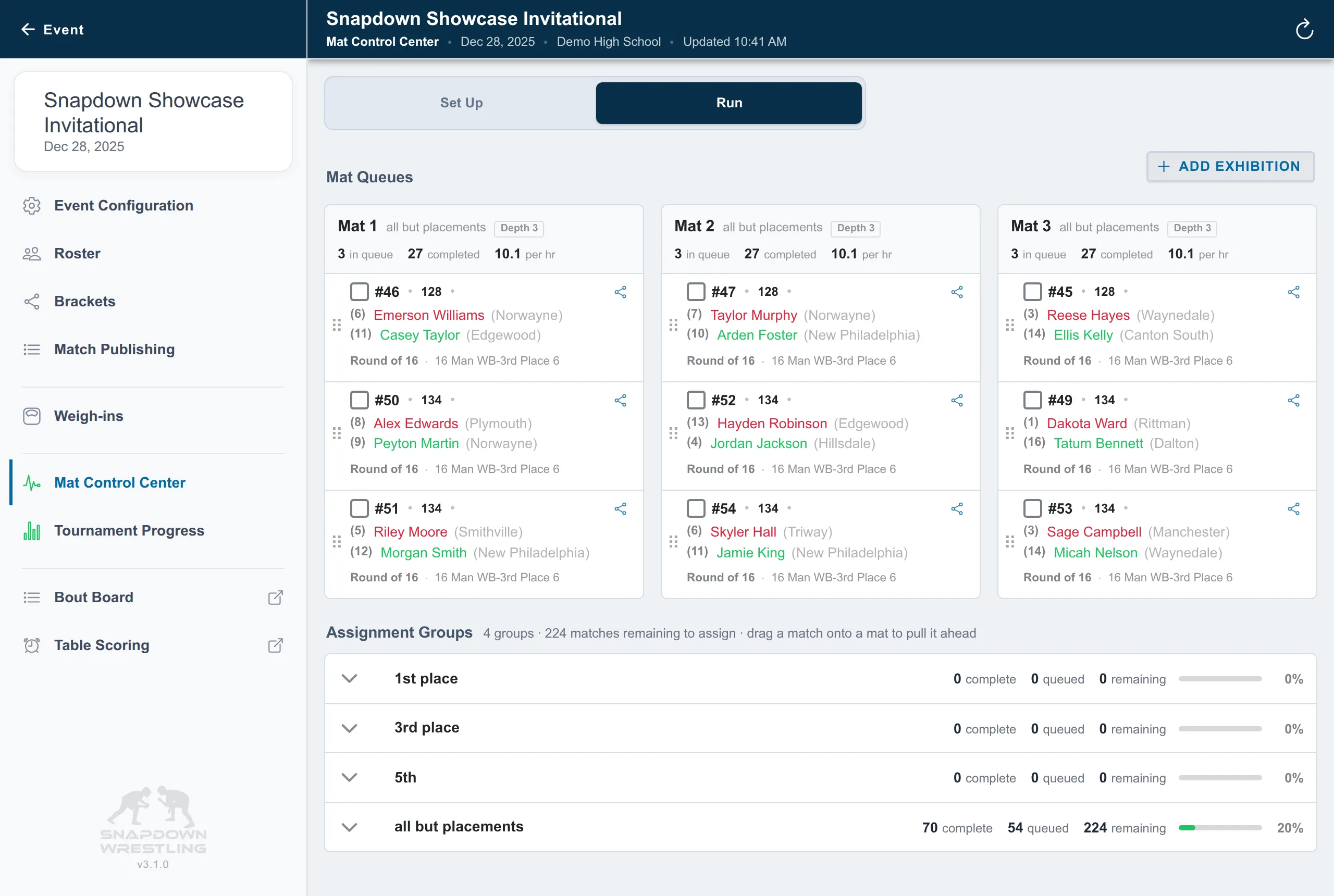
How matches reach a mat
Matches are not pushed by hand one at a time. Each mat is assigned a group of work, and an active mat pulls its next match from that group automatically as matches complete.
Two settings control it, both in Mat Configuration:
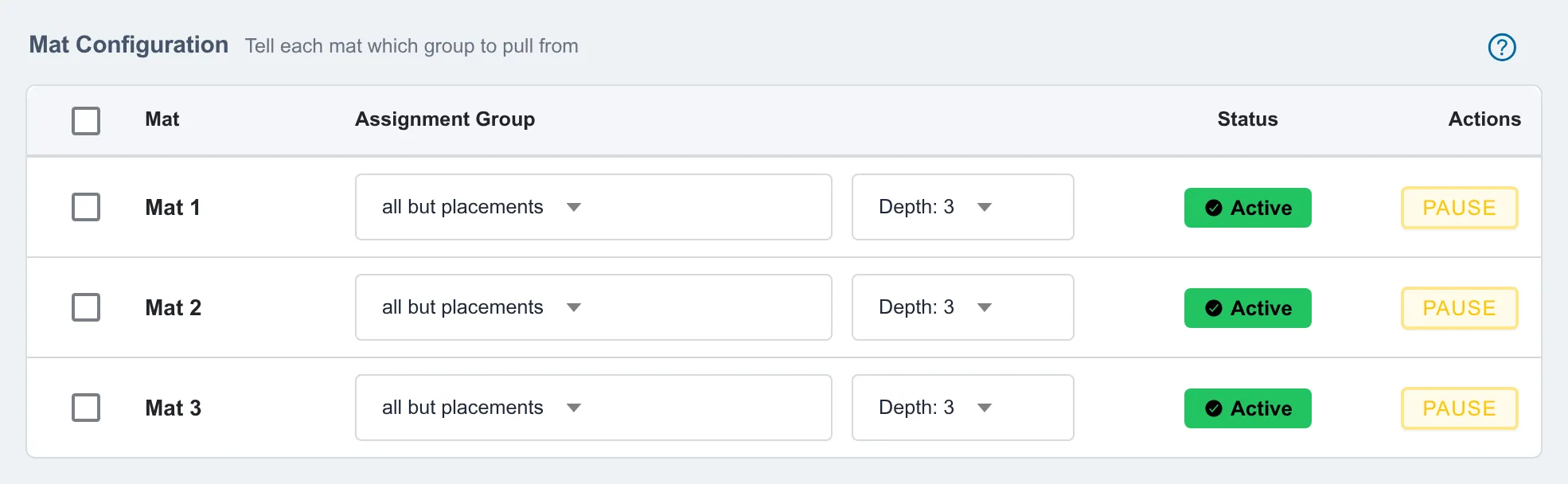
Assignment Group decides which brackets or rules feed that mat. A mat with no group set shows No group set and will sit empty. You can switch a mat to a different group mid-tournament, which is how you move a division to a fresh mat when the day changes shape.
Status is Active, Paused, or Inactive. Active mats pull matches from their assigned group. Pausing a mat stops automatic backfill when its current matches complete, which is what you want during an award ceremony or a mat break. Inactive mats take no work at all.
Queue depth
Queue depth is how many matches are staged on a mat ahead of the one being wrestled. Set it from 1 to 8, or All to stage everything.
Depth is set per rule, not per mat. The screen does not make that obvious. Changing depth on one mat changes it for every mat fed by the same rule.
Depth is a tradeoff, and it is really about how early a wrestler gets called:
- Deeper queues call wrestlers to the mat further ahead. Coaches and families get more warning, and the mat is less likely to run dry. The cost is that a wrestler can be staged for a match that is still several bouts away, which is uncomfortable when they also have a bout on another mat.
- Shallower queues keep wrestlers free until close to their bout, at the cost of less notice and less slack when a match ends early.
Depth of 2 or 3 suits most events. Go deeper on a slow-moving mat, shallower when wrestlers are competing across several mats at once.
On a custom schedule, both the rule and the depth are editable inline on this screen, and a Pending change marker appears until the change takes effect. On an automatic schedule, the rule and depth come from the generated schedule, and this screen displays them without editing.
Watching for trouble
Mat Queues is the live picture. Read it across all mats rather than one at a time.
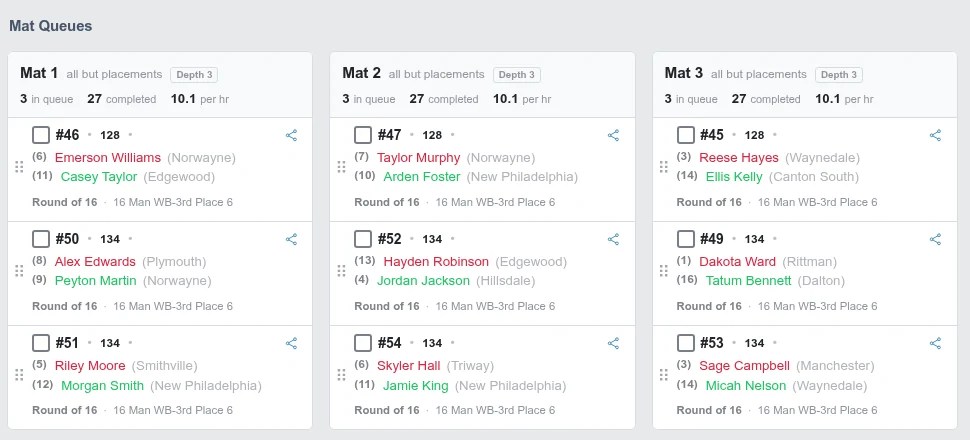
An empty queue while other mats are backed up usually means that mat’s assignment group is finished, or the mat never had a group set. Give it a group with work left, or move a bracket over.
A mat that is not advancing is almost always a match nobody submitted. The table has to choose Submit Completed Match before the next one loads, so walk over and check the mat before assuming the queue is broken.
A paused mat stays where it is by design. Pausing is easy to forget once the ceremony you paused it for is over.
Unloading a mat
When a mat has the wrong work on it, select the mats and unload them. Snapdown confirms first, and the change is reversible: unloading returns waiting matches to the assignment queue, where they can be loaded again.
Started, completed, and bye matches stay on the mat. That is the part worth understanding before you unload. A bye that already completed also already advanced its wrestler, and unloading does not undo that advancement. Unload clears work that has not begun, not the day’s history.
The other two event-day screens
Directors mix these up at their first event, so name the person as well as the screen.
- Score matches at a table — one screen per scoring table, showing a single match at a time. Used by the table worker.
- Set up the Bout Board — the public display. Wrestlers, coaches, and families read it to know what is up next. Nobody operates it.