


Custom matchup algorithms
Snapdown builds the matchups.
From the wrestlers who checked in, inside your league's rules. Weight, age, skill, results, team, and who they wrestled last week.
We'll walk through your setup with you and provide a free practice event for your staff. Ask for a walkthrough or practice event →
See how it works ↓What the pool actually is
A roster is not a matchup pool.
Every week the list you planned around and the wrestlers standing in the gym are two different lists. Snapdown builds from the second one.
The pool we build from
The wrestlers who are in the gym, on the scale, and eligible to go.
Your rules applied
Weight, age, skill rank, team separation, and who they already wrestled.
Balanced groups
Built after check-in, not from Thursday night's best guess.
Snapdown was built in an 18-team league of about 650 wrestlers, where reconciling those two lists by hand took 10–20 hours a week and still fell apart on Sunday morning.
Four steps, one morning
From check-in to matchups.
The groups get built after check-in, from the wrestlers in the building.
- 01
Check in today's wrestlers
Load everyone ahead of time. On event day, only the wrestlers who check in are in the pool.
- 02
Apply your league's rules
Age gap, weight spread, skill spread, teammates, rematches. Your limits, not defaults somebody else picked.
- 03
Compare thousands of possible groups
Snapdown scores whole sets of groups against each other and keeps the best one. It is not sorting a list by weight.
- 04
Review, adjust, publish
The strongest overall set of three- and four-wrestler groups, not one great matchup paid for by two bad ones. You still have the final say before anything is published.
The wrestler score
Each wrestler carries a competitive rating built from:
- ✓ Weight and age
- ✓ Coach-assigned skill rank
- ✓ Win/loss record
- ✓ Total match experience
A 10-year-old with 50 matches is not the same wrestler as a 10-year-old in their first season, even at an identical weight. Every coach in the gym knows that. The score knows it too.
Ranks over the season
Ranks move with the results.
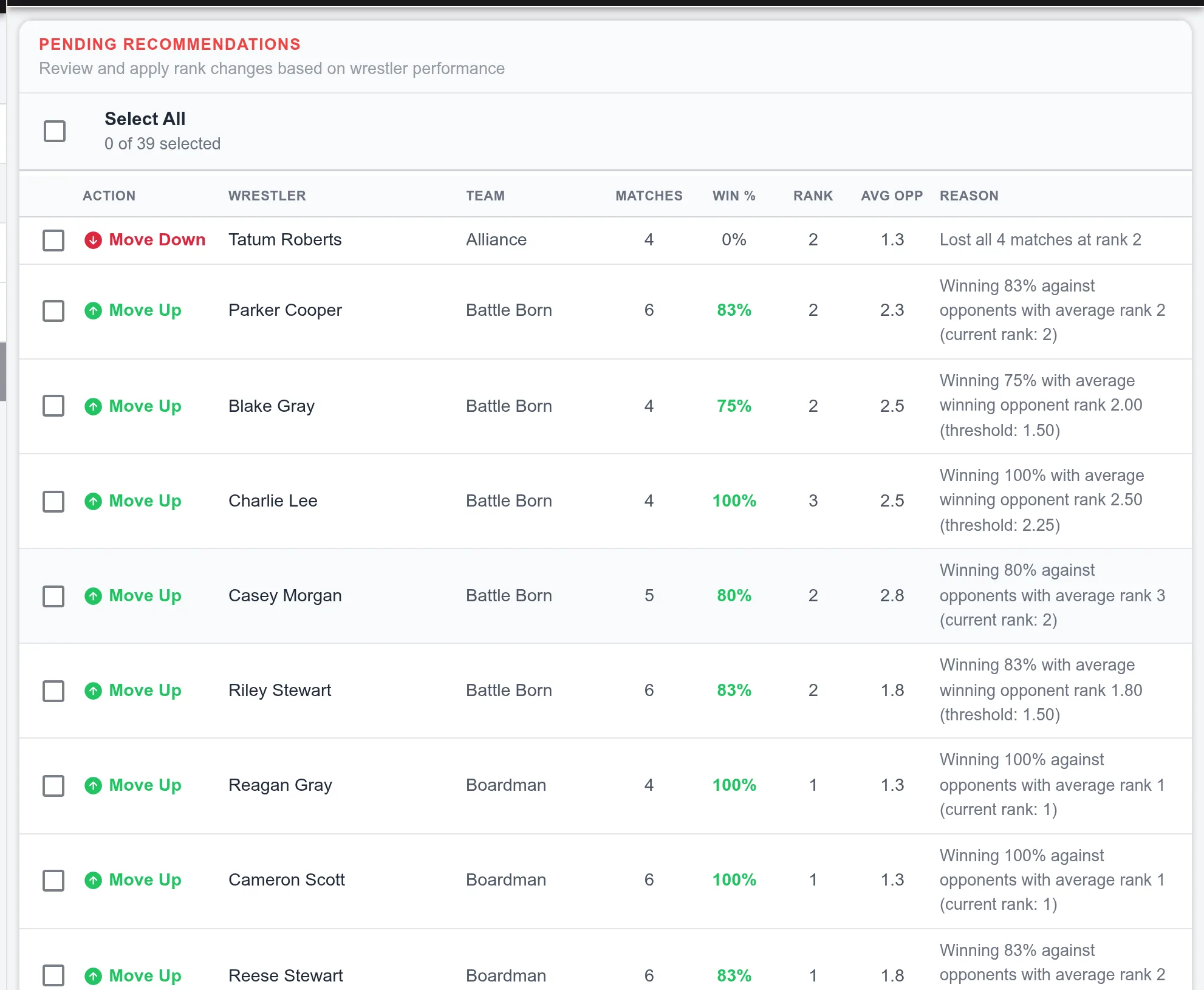
A coach rank starts the season. Match results add evidence. Snapdown then recommends rank changes with the record behind them, a league director approves or ignores each one, and the next matchup pool reflects what wrestlers have actually done rather than what somebody guessed in November.
- 1. Start with coach knowledge
- 2. Capture real match results
- 3. Review rank recommendations
- 4. Improve the next matchup pool
What it handles
Every one of these is a decision a director used to make by hand, for every group, every week.
- A rating that knows more than a coach ranking
- Coach rank is the starting point, not the whole answer. Results, match experience, age, and weight fill in the rest of the picture.
- Ratings that move with the season
- Match results surface evidence-backed rank recommendations, and the league director reviews and approves them. Nothing changes behind your back.
- Your rules, your limits
- Set the max age gap, weight difference, and skill spread. Snapdown finds the best groups inside those limits instead of arguing with them.
- Teammate handling with a middle setting
- Block same-team matches, allow them, or discourage them. Discourage means teammates only meet when every alternative is worse.
- It remembers last week
- Snapdown tracks who wrestled whom. Two kids who just met do not get matched again while there is anyone else to wrestle.
The right structure for the event
Choose what matters. Snapdown builds the groups.
Some events need the strongest overall matchups. Others need official places, or fast weight-based groups so the little kids get called together. Pick the outcome; the optimization details stay under the hood where they belong.

Running an open tournament that separates wrestlers into age divisions before grouping by weight? See Snapdown tournament software →
You set the limits. It works inside them.
Every league runs different, and none of them want to argue with a piece of software about it. These are the rules a league director sets:
- Max age gap
- How many years apart wrestlers may be
- Max weight difference
- Percent of the lighter wrestler
- Max skill gap
- Coach rank difference
- Teammates
- Block, allow, or discourage same-team matches
- Mixed brackets
- Boys and girls together, or separate
2 years
10%
2 levels
Discourage
Allowed
Example values from a real youth league configuration.
Frequently Asked Questions
How long does it take to generate brackets?
It depends on roster size, your matchup limits, and the grouping method. Small groups come back fast; optimizing a large ability-based pool takes longer, because Snapdown is genuinely comparing many combinations rather than sorting a list.
What information does the algorithm use?
Weight, age, grade, coach ranking (1–5), match experience, results, team, and previous opponents. Together they build competitive groups while staying inside your league rules.
What if a coach ranking is off?
Coach rankings are a useful starting point, but real performance often tells a different story. Snapdown surfaces rank recommendations with the record, confidence, and match evidence behind them, and a league director decides. Approved ranks make the next matchups better.
What if a wrestler does not fit anyone?
Snapdown loosens the rules a little for that kid, maybe allowing a slightly wider age gap, and flags them either way. If nothing works, you see it before the event instead of during it, and a coach can set up a specific match.
How does "discourage same-team" actually work?
Teammates carry a penalty in the scoring. They face each other only when splitting them up would create a worse problem somewhere else, like a real weight mismatch two groups over.
Can we run mixed brackets?
Yes, and you can keep boys and girls separate instead. Individual wrestlers can also opt out of mixed matches, and Snapdown respects that when it builds the groups.
Does it track matches across multiple weeks?
Yes. Recent matches, the last week or two, are actively avoided. Older meetings carry less weight, because by then it is a rematch worth having.
Start your league.
Create your league at checkout, or show us how you group wrestlers today and we'll show you what Snapdown does with the same roster.
$250 for the season. Unlimited events, wrestlers, and matches.